


Sie befinden sich hier
Inhalt
DFG-funded Research Group FOR 2690 (2018 – 2025)
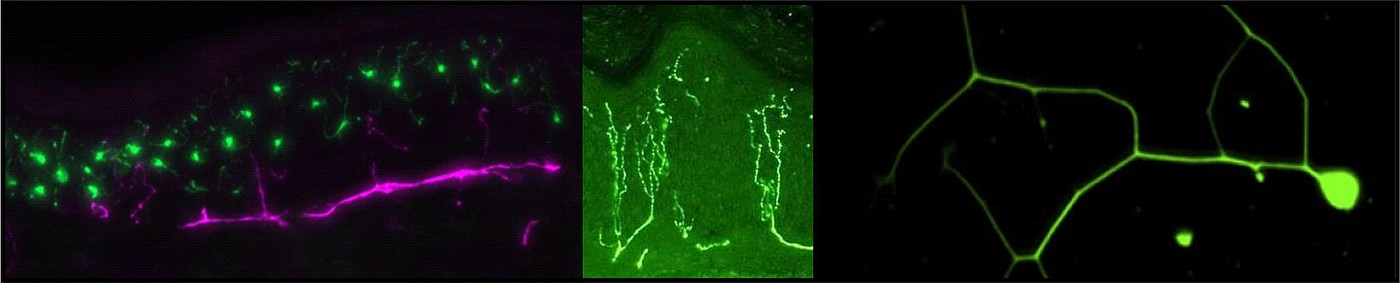
Our consortium deepened the neurophysiologic basis of itch by revealing a specific class of C-fiber pruriceptors—termed C-OSMR-SST neurons—expressing the complete transduction cascade for Interleukin-31 and being responsive to pruritogens like IL-31, leukotriene C4, and histamine. These neurons, conserved across pig, monkey, and human, uniquely respond to slow depolarizing electrical pulses, validating our selective activation protocol. This supports the "labelled line" theory of itch, while our single-fiber recordings in humans also confirm the "spatial contrast" theory, where slow bursting patterns in polymodal nociceptors induce itch rather than pain.
Methodologically, improved analysis techniques enabled quantification of spontaneous C-nociceptor activity in hepatobiliary pruritus by microneurography. Dermal microdialysis and microneedle sampling allow precise measurement of RNA species in eczema and atopic dermatitis, while keratinocyte stretch chambers modeled scratch-induced transcriptomic changes. Spatial transcriptomics and novel structural metrics—such as intraepidermal nerve fiber branching—enhance specificity and objectivity in assessing sensory sensitivity.
In dermatologic diseases, scratching promotes nerve fiber branching, reinforcing the itch-scratch cycle. Crucially, electrically induced itch occurs in atopic dermatitis, but not psoriasis, aligning with the presence of IL-31RA+/histamine-sensitive pruriceptors, specific T-cells (effector memory T-cells) as IL-31 source and the anti-pruritic efficacy of anti-IL-31 and JAK inhibitors in atopic dermatitis, but not psoriasis. These differences might well explain distinct scratching behavior in these conditions. In systemic itch (e.g., hepatobiliary and myeloproliferative diseases), a hallmark finding is the switch from electrically induced pain to itch—driven by sensitization via histamine-sensitive pruriceptors. This is corroborated by clinical success of JAK1/2 inhibitors and microneurography data showing spontaneous activity in both polymodal and silent nociceptors.
In neuropathic itch, the consortium unified dermatological and neurological perspectives, identifying it as a common, clinically significant symptom in polyneuropathy. Tonic electrical stimulation of C-fibers best correlates with clinical pain ratings, reflecting ongoing nociceptor activity. No clear predictive phenotype for neuropathic itch was found.
Key conceptual advances of the consortium include: (1) the central role of C-OSMR-SST neurons in chronic itch; (2) the importance of nerve branching and local neurotrophic/repellent gradients in distinguishing neuropathic from non-neuropathic itch; and (3) the recognition that chronic itch involves peripheral and central sensitization—now formally integrated into the updated definition of itch, marking a conceptual leap beyond pain research, where chronicity is still defined by duration alone.







Kontextspalte

FOR 2690 – Translational Pruritus Research „PruSearch”
Ludolf-Krehl-Str. 13 – 17
68167 Mannheim
FOR2690@medma.uni-heidelberg.de
Spokesperson

Prof. Dr. med. Martin Schmelz
Director Dept. for Experimental Pain Research
Medical Faculty Mannheim, Heidelberg University
Phone +49 621 383-71650
martin.schmelz@medma.uni-heidelberg.de
Vice Spokesperson

Prof. Dr. med. Dr. h. c. Sonja Ständer
Head of Center for Chronic Itch,
Department of Dermatology,
University Hospital Münster, Germany
Phone +49 251 83-57470
sonja.staender@uni-muenster.de
Project Coordinator

Ilona Rossbach
Dept. for Experimental Pain Research
Medical Faculty Mannheim, Heidelberg University
Phone +49 621 383-71650
ilona.rossbach@medma.uni-heidelberg.de