


Sie befinden sich hier
Inhalt
Date: 29.04.2026
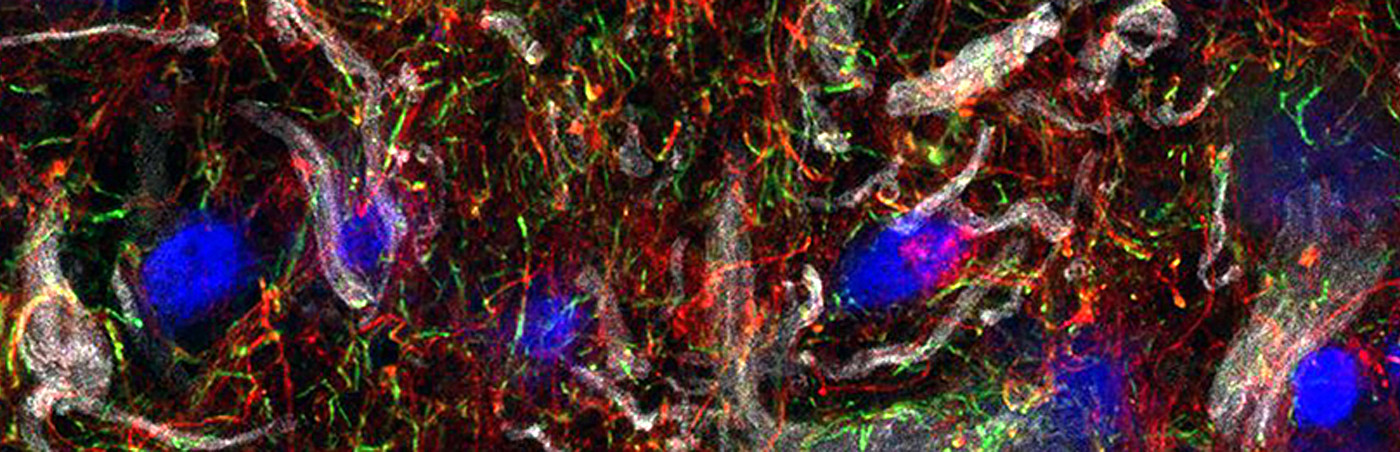
A collaborative research team led by Lukas Bunse has gained new insights into the role of the immune system in Alzheimer’s disease. The study, now published in the journal Nature Communications, shows that not only innate immune cells but also specialized T cells play a central role in inflammatory processes in the brain.
Deposits of the protein amyloid-beta are considered a key hallmark of Alzheimer’s disease. Until now, research has primarily focused on so-called microglia ̶ immune cells of the brain that respond early to these deposits. The current work now shows that the situation changes over the course of the disease: as the disease progresses, T cells increasingly move to the forefront of the immune response.
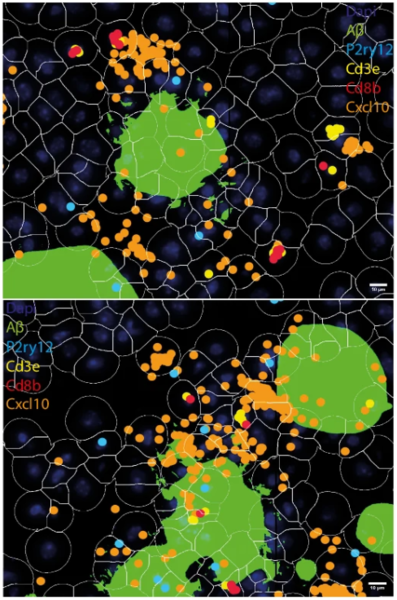
“We observed that certain CD8 T cells ̶ immune cells that recognize infected or abnormal body cells ̶ specifically accumulate near amyloid plaques,” explains project leader Lukas Bunse. “These cells exhibit a distinct activation pattern controlled by so-called type I interferons.”
Targeted Immune Response in the Brain
Using state-of-the-art single-cell analyses, the researchers examined the immune landscape in the brains of mouse models with an Alzheimer’s-like condition. In doing so, they identified a specific subgroup of T cells that produces pro-inflammatory signaling molecules. Particularly important here is the molecule CXCL10, a so-called chemokine ̶ a messenger substance that directs immune cells to specific locations in the body ̶ thereby attracting additional immune cells and potentially triggering a kind of chain reaction.
These mechanisms were also detected in human brain tissue with amyloid deposits, suggesting that the findings are highly relevant to the human disease.
Dynamic Shift in Inflammation
A key result of the study is that the driving forces of inflammation change over the course of the disease: while microglia dominate in early stages, T cells increasingly take over control of the immune response at later stages. This temporal shift could be crucial for the development of new therapies.
“Our data suggest that therapies should be tailored more closely to the stage of the disease than has been the case so far,” says Bunse. “The timing of intervention in the immune response could be decisive.”
New Therapeutic Perspectives
The identified signaling pathways ̶ particularly the type I interferon response and the CXCL10-mediated recruitment of T cells ̶ offer potential targets for new treatment strategies. Initial experimental approaches indicate that targeted blockade of these pathways could reduce inflammatory processes in the brain.
However, previous studies also show that interventions in the immune system can have different effects depending on the disease stage ̶ ranging from harmful to protective. Future research will therefore need to determine when and how such therapies can best be applied.
Research at the Interface of Immunology and Neurology
Since 2026, Lukas Bunse has been Professor of Neuroimmunology with a focus on cell therapy at the Medical Faculty Mannheim. His research aims to harness the immune system in a targeted way against diseases of the central nervous system ̶ both in brain tumors and in neurodegenerative and autoimmune disorders. With a translational approach, his research group seeks to develop new immunotherapeutic strategies and bring them into clinical application.
Original publication:
Type I interferon drives T cell responses to amyloid beta in the central nervous system
Michel JJ, Sanghvi K, Rosenbauer J, Humbs L, Dierssen CT, Grudzenski-Theis S, Sachs V, Jähne K, Degenhardt K, Frölich L, Herms J, Fatar M, Platten M, Bunse L.
Nature Communications. 2026 Apr 23;17(1):3737
DOI: 10.1038/s41467-026-72262-6
Press release of the Medical Faculty in Mannheim (in German):
05.05.2026 Wie Immunzellen Alzheimer beeinflussen: T-Zellen rücken ins Zentrum der Forschung