


Sie befinden sich hier
Inhalt
Date: 31.07.2025
Heidelberg University has successfully secured funding from the German Research Foundation (DFG) to establish a new research group in basic biomedical science. Titled "Dynamic integration of GPCR signaling to control organ function and animal behaviour" (DynOrg), the research group will investigate how organisms adapt their organ function and behavior to constantly changing environmental conditions. Researchers from the Medical Faculty Mannheim and eight other German universities will conduct the investigation.
Prof. Dr. Simon Wiegert, head of the Department of Neurophysiology at the Medical Faculty Mannheim and MCTN co-director, will coordinate the group in collaboration with Prof. Dr. Dr. Tobias Brügmann from the University Medical Center Göttingen. The DFG will fund the project with €5 million over the next four years.
Animals, including humans, must continually adjust to threats such as heat or predators. These physiological and behavioral responses are mediated by complex interactions between the central and autonomic nervous systems and often involve changes in heart function and alertness. A few chemical messengers acting through a large family of G protein-coupled receptors (GPCRs) are central to these adaptive processes, translating external signals into cellular responses.
"Although we understand many of the components of these signaling pathways, we still lack a fundamental understanding of how GPCR signaling controls organ function and behavior," says Prof. Wiegert. "Our goal is to uncover the core principles of these mechanisms across different model organisms."
The new research group brings together leading experts in GPCR signaling, optogenetics, and physiology, and builds on the collaborative foundation of the DFG Priority Program "Next Generation Optogenetics". Optogenetics – the use of light to precisely control cell activity – will play a central role in the group’s experimental strategies.
"Our interdisciplinary approach aims to answer key biological questions at the intersection of organ function, behavior, and disease," Wiegert explains. "We specifically explore GPCR-mediated communication between the brain, heart, and environment."
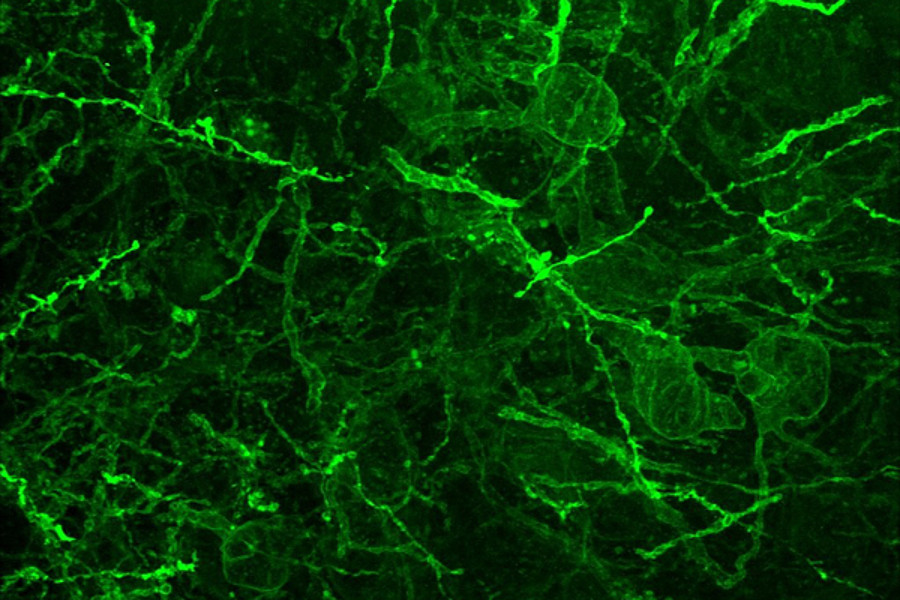
Figure: Visualization of a GPCR ligand in nerve cells
This image shows an optical sensor for the GPCR ligand noradrenaline in brain neurons. The neurons were labeled with a green fluorescent sensor protein that detects noradrenaline, a key neurotransmitter that binds to various GPCRs and regulates essential bodily functions, including heart performance and brain activity. When noradrenaline reaches the neurons, they light up - making the transmitter’s effect visible. © Department of Neurophysiology, Medical Faculty Mannheim
FOR 5807 – DynOrg Website:
www.for5807.de
Press Release by the German Research Foundation:
02.07.2025 DFG to Fund Seven New Research Units
Press Release by the Medical Faculty Mannheim (German Language):
17.07.2025 Neue DFG-Forschungsgruppe von Mannheim aus koordiniert
News Release by Heidelberg University: